
 Español
Most fast casino games ask one question: how long can you hold? Dig Deeper asks a different one, over and over. A risk and reward game built around a hidden grid, it turns every safe step into a fresh cash-out decision, so the player is never a passive spectator waiting for an animation to finish. They decide when to stop.
That decision-driven structure makes the format compelling—and makes it a useful addition to a lobby full of spinning reels. This article explains how Dig Deeper works, how adjustable difficulty changes the experience, what a 96.00% RTP means here, how provable fairness covers every grid, and where the format performs best.
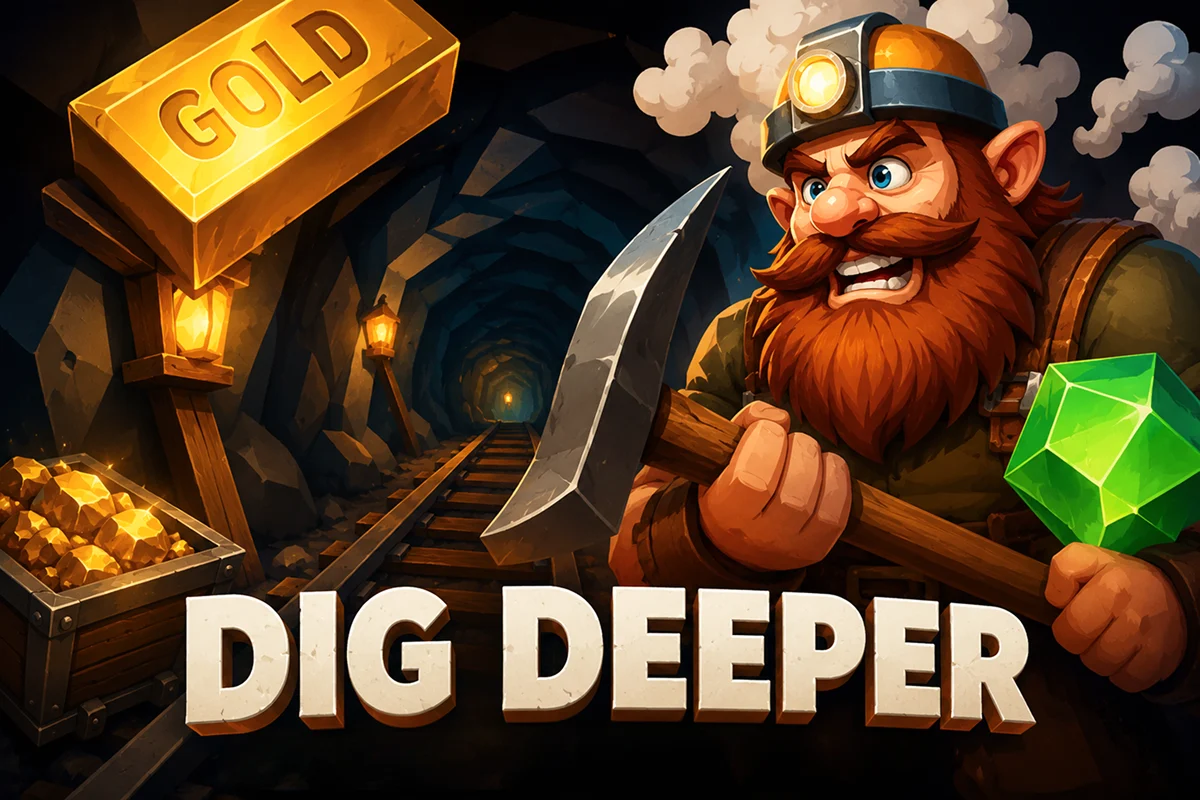
Zero Dash Dig Deeper: reveal gems, avoid the stones, and decide when to bank your winnings.
How this risk and reward game works (gems, stones, round ends)
Dig Deeper is played on a hidden grid. Behind each tile sits either a gem or a stone. The player chooses a stake and a difficulty setting, then begins revealing tiles one at a time. Every safe reveal is a gem: it raises the current multiplier and keeps the round alive. Every wrong choice is a stone: the round ends immediately and the stake is lost.
At any point after a safe reveal, the player can stop and collect. The payout is the stake multiplied by the multiplier they have reached. There is no obligation to clear the grid and no penalty for leaving value on the table. The game is a negotiation between greed and the exit button, and the player controls both sides.
The core loop: cash out or push deeper?
The heart of Dig Deeper is a repeating fork. After each safe reveal, the player faces the same choice: bank what is guaranteed, or risk it for a larger multiplier on the next tile. Crucially, the risk is real and immediate. The next tile could be a gem, which increases the payout, or a stone, which erases the entire round’s progress.
What makes this loop different from crash is the granularity. In a crash game, the decision is continuous and time-pressured. In Dig Deeper, the decision is discrete: one tile, then another, with as much or as little time between choices as the player wants. That makes it a more deliberate, more strategic experience and, for many players, a more comfortable one. Showing the profit available now and the potential profit on the next tile turns the game from a gut-feel gamble into a sequence of informed choices. That discrete, step-by-step decision is the heart of the Dig Deeper game, which is why it plays more deliberately than a timed multiplier.
Adjustable difficulty: tune risk and reward for your audience
Dig Deeper lets the player set the difficulty before the round. The lever is the number of stones hidden in the grid. A low stone count makes each reveal safer and the multiplier grows slowly; a high stone count makes disaster more likely but raises the reward for every safe step.
For operators, adjustable difficulty is a portfolio feature disguised as a setting. It removes the need to source separate low- and high-volatility titles, and it gives retention teams something concrete to talk about in campaigns: a “safe route” challenge for one segment, a “deep run” leaderboard for another. Our guide to max win and hit frequency explains how to read those settings against your players’ actual behavior.
Increasing payouts and the math (RTP 96.00%)
Dig Deeper runs at a 96.00% return to player, leaving a 4.00% house edge over the long run. The multiplier ladder is built so that each safe step pays progressively more, reflecting the growing rarity of surviving that far. The deeper the run, the larger the multiplier, and the smaller the probability of reaching it.
Because the payout scales with the risk, the game can be played gently or aggressively with the same expected return. Cashing out after one safe tile on a low-stone grid produces a small, frequent win; pushing deep on a dense grid produces a rare, large one. Over millions of rounds both sit inside the 96.00% envelope. That is the same insight that governs volatility across casino games generally: the edge is constant, but the shape of the ride is a matter of player choice. For a fuller explanation, see our article on RTP, house edge and volatility.
Player psychology: loss aversion, near-miss, and “one more step”
The pull of Dig Deeper is deeply human. Behavioral research on loss aversion, the concept pioneered by Kahneman and Tversky, shows that the pain of a loss is felt more intensely than the pleasure of an equivalent gain, often described as roughly twice as powerful. In practice, that asymmetry makes players reluctant to lock in a modest result when a bigger one feels within reach. That is the engine behind the “one more step” feeling: once several gems are revealed, the multiplier on screen is something they own, and the possibility of losing it is weighted heavily.
Near-misses add a second layer: a stone that appears just after a safe exit produces a strong emotional spike. Designers must be careful here. Under the Gambling Commission’s remote technical standards, games may not falsely display near-miss results, meaning a losing outcome cannot be substituted to manufacture that feeling. In a fair grid game the near-misses are genuine, which is why they land so hard.
The responsible approach is to design around this psychology rather than exploit it. Clear payoff displays, an honest cash-out value, and visible stake controls all help players make deliberate decisions instead of reactive ones. Our piece on responsible gaming by design is the natural companion for that work.
Provably fair: every grid verifiable
Dig Deeper is provably fair. Before a round, the server commits to a hidden seed by publishing its hash; the player’s client seed and a round nonce are combined with it to determine the entire grid. After the seed is rotated, the original server seed is revealed, and the player can recompute the layout to confirm that the positions of every gem and stone were fixed before they placed their bet.
For a game where a single decision can end a round, that proof is the whole trust story. The player is not asked to believe that the board was fair; they can check it. As with any provably fair system, this transparency layer complements rather than replaces independent testing. Under the Gambling Commission’s standards, RNG and game outcomes must be acceptably random and demonstrable, and accredited labs such as eCOGRA certify RNG and RTP performance for licensed operators, who are themselves overseen by regulators such as the Malta Gaming Authority. For a technical walkthrough, see our provably fair deep dive and our overview of provably fair gaming.
Video: loss aversion and prospect theory explain why the pain of losing outweighs the pleasure of winning — the bias behind every cash-out or push-deeper decision (source: YouTube / McCombs School of Business, UT Austin).
Customization: theme, difficulty, stake, branding
Dig Deeper is designed to be re-skinned without touching its fairness or its math. The theme, symbols, colors, and copy can be adapted to a brand or campaign, and the difficulty range, multiplier ladder, and stake limits can be configured for a market. Currencies and languages are handled by the same platform layer as our other titles.
Because the core interaction is a grid and a button, the game is also easy to localize for different regulatory environments, where stake caps and display requirements vary. Operators who want ownership of the format can choose a white-label or custom build and run it through ZeroEngine, which handles distribution, wallet calls, and reporting. The Dig Deeper game page lists the current configuration options.
Best fit: where this format performs (mid-length sessions, strategic players)
Dig Deeper performs best where players want more than a reflex test. Its natural audience is strategic: players who enjoy weighing a decision, who like seeing the value of their run climb, and who are happy to cash out rather than chase. That makes it a strong fit for mid-length sessions between the extremes of a one-tap instant game and a long slot grind. If you already offer a classic crash title, Dig Deeper gives players a calmer, turn-based alternative; our comparison of Altitude versus crash game formats explains the difference, and our coinflip game covers the shortest end of the spectrum.
Frequently asked questions
Is Dig Deeper skill-based?
No. Dig Deeper is a game of chance. The layout of gems and stones is fixed by a random process before the player begins, so no choice changes the odds of the next tile. What the player controls is how much risk to accept and when to stop, which affects the shape of the session and the variance, not the underlying edge.
What happens if you hit a stone?
The round ends immediately and the stake is lost, regardless of how many gems were revealed before the stone. Because the player can cash out after any safe reveal, the entire risk of a round is concentrated in the decision to keep going.
Can difficulty be customized?
Yes. The number of stones in the grid is the difficulty control, and it can be configured within a range for each market. Fewer stones mean safer, slower-growing rounds; more stones mean higher risk and larger multipliers. Players choose where to play inside the operator’s configured range.
Bring a decision-driven game to your players
Dig Deeper gives strategic players a format where every step is theirs to make. Adjustable difficulty, transparent payouts and provable fairness make it a natural fit for a lobby that already values fast, decision-led titles.